The LM4780 power amplifier IC used in Genelec 8030A active studio monitors has now become one of the components that is difficult to find on the market. Especially in recent years, the fact that many LM4780 ICs bought from Aliexpress and similar platforms turned out to be fake has seriously complicated the repair process.
One of our readers reported that a Genelec 8030A studio speaker was faulty. The sound is low and there is distortion. The amplifier stage uses an LM4780 IC, but this IC is not available on the market. The LM4780 ICs bought through Aliexpress also turned out to be fake and did not work.
For such unavailable amplifier ICs used in sound systems, amplifiers, etc., the solution I use is to connect a different IC as a module, as a small kit, or with surface mounting on the heatsink, etc.
However, LM4780 is a Hi-Fi standard amplifier IC. In other words, not every IC will work. The most suitable alternative (even better) is 2 pieces of LM3886. When I examined the internal structure of LM4780, it already looked like two LM3886 ICs combined in a single package; there is almost no difference in the application circuits*
How Similar Are LM4780 and LM3886?
Contents
When the datasheet application circuits are examined, it is clearly seen that LM4780 actually contains two LM3886-like amplifier blocks inside the same package. The input structure, feedback connection, mute control, and output topology operate largely with the same logic.
In the application schematics below, the dual-channel structure of LM4780 is shown on the left, and the single-channel LM3886 application is shown on the right.
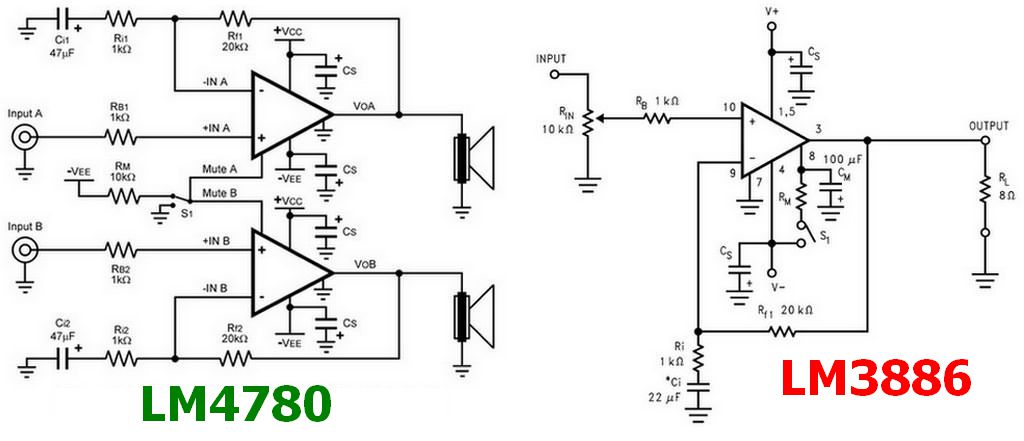
In both circuits:
- Non-inverting input structure is used
- There is a 20k feedback resistor
- A 1k input resistor is preferred
- A mute control pin is available
- A symmetrical power supply structure is used
Thanks to this similarity, it is practically possible to use two independent LM3886 ICs instead of LM4780.
As an example of Hi-Fi applications made with LM3886, you can also take a look at the LM3886TF speaker-protected stereo amplifier circuit article.
Pin Structure Examination
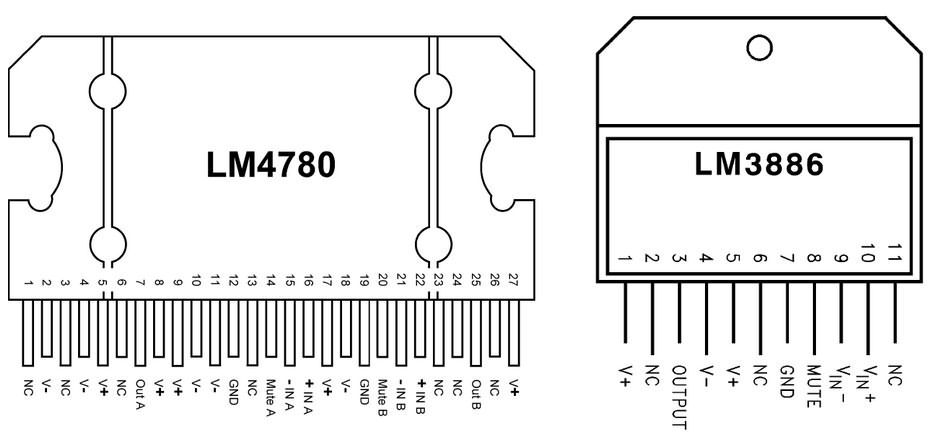
When the datasheet pinouts are compared, it can be clearly seen that LM4780 combines two independent amplifier blocks in a single package.
| LM4780 | Equivalent | LM3886 |
|---|---|---|
| +IN A | Channel A input | +IN |
| -IN A | Channel A feedback | -IN |
| OUT A | Channel A output | OUTPUT |
| Mute A | Channel A mute | MUTE |
| +V / -V | Power supply | V+ / V- |
| +IN B | Channel B input | +IN |
| -IN B | Channel B feedback | -IN |
| OUT B | Channel B output | OUTPUT |
| Mute B | Channel B mute | MUTE |
The point to pay attention to here is that some pins of LM4780 are “NC”, meaning not connected. These pins were specifically left empty in the PCB design.
Converter PCB Design
Since there is not much mounting space inside the Genelec 8030A, the PCB was designed as compactly as possible. The dimensions are around 40.5×19.7mm. Two LM3886 ICs were placed in the upper section, and connections compatible with the LM4780 footprint were created on the lower side.
The PCB design was prepared with Sprint Layout 6.
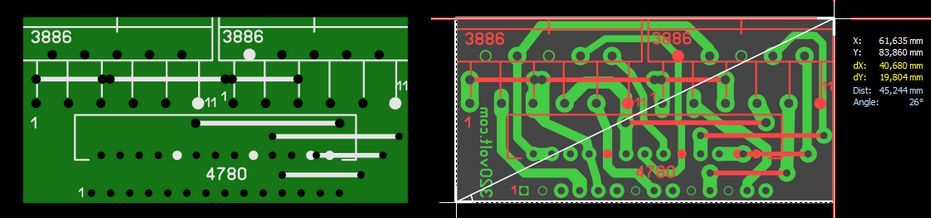
The red lines seen on the PCB represent the upper-layer jumper connections. The green tracks are the lower-layer copper tracks.
The tracks on the lower side will be completely solder-coated. Reinforce the power supply and output sections with extra solder filling, and make the jumper wires 1mm thick.
In addition, I also prepared a double-layer drawing of the same design. The same tracks were added as the upper layer only to make the tracks thicker; these do not have solder mask.
If you will have a double-sided PCB made in China, the upper layer tracks will be covered, but when installing the jumpers, leave them slightly raised so they do not touch the tracks.
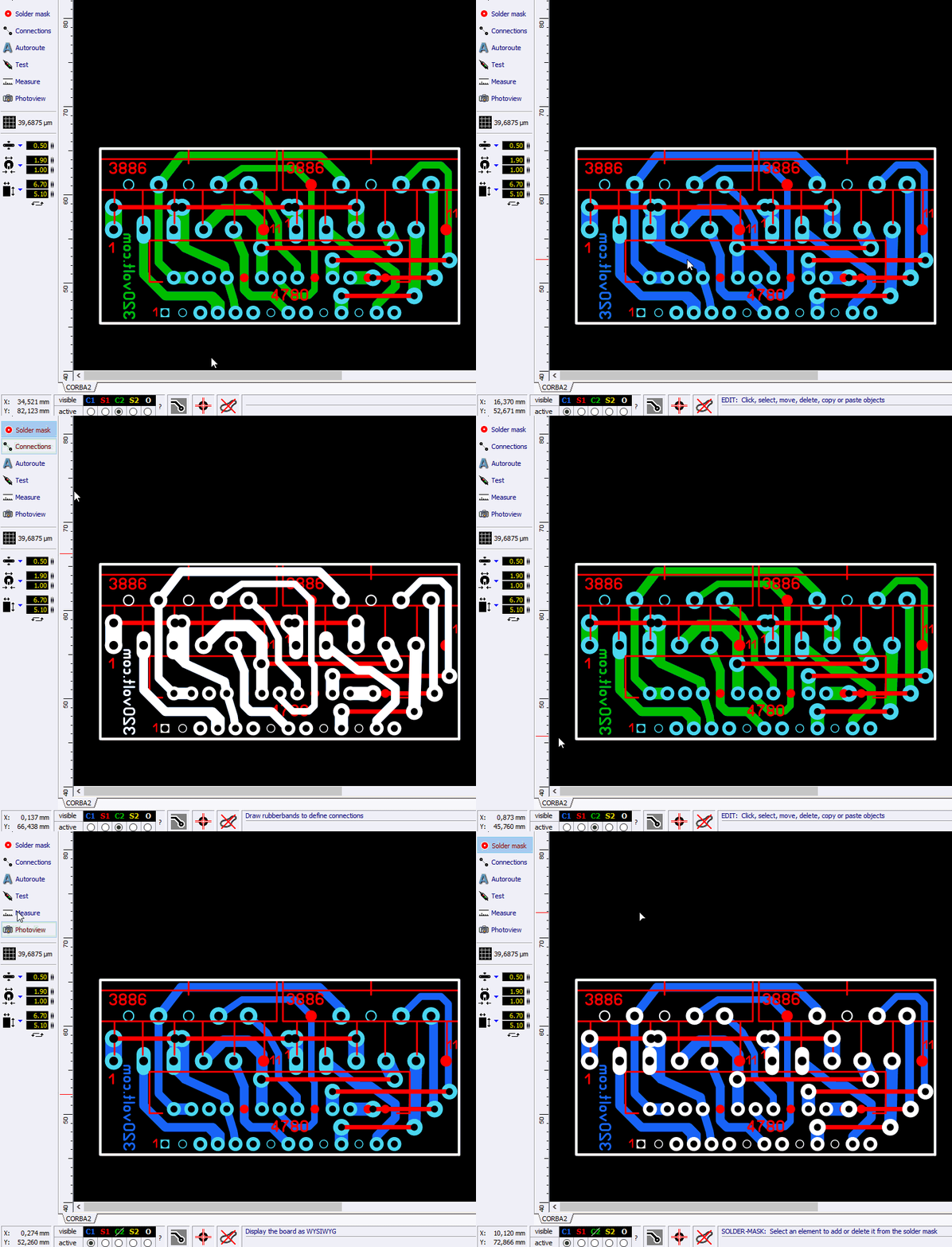
Special attention was paid to the following details in the design:
- Output tracks were kept thick
- Power supply lines were drawn short and wide
- Mute pins were routed separately
- Feedback tracks were routed away from the output line
- Ground returns were kept as short as possible
Mute Circuit Compatibility
For LM3886 to operate, the mute pin must be biased correctly. The RM resistor and CM capacitor seen in the datasheet circuit are used for this.
LM4780 also has separate mute pins in a similar way:
- Mute A
- Mute B
In the PCB adapter, these pins were directly routed to the related LM3886 mute inputs. Thus, Genelec’s original standby/mute control structure was preserved.
Heatsink and Mechanical Placement
In the Genelec 8030A board images sent to me, I saw that there was no heatsink for LM4780. I think that since it is a studio speaker, it is not operated at high powers, and the sound limiting was designed accordingly.
If a heatsink is used in the device you will use, since LM4780 is a single package, a single contact surface is used in the original design. In this conversion, however, since two LM3886 ICs are used, the heatsink pressure must be equal.
If the LM3886T metal-tab package is used, the insulation washer must not be neglected. Otherwise, a power supply short circuit may occur.
PCB height is also an important issue. Since there is limited clearance between the board and the rear panel inside the Genelec 8030A, electrolytic capacitor height and solder overflow should be checked.
First Startup Test
| Check | Expected Condition |
|---|---|
| No-load current | Should not rise excessively |
| Output DC level | Should be as low as possible |
| Heatsink temperature | There should be no rapid overheating |
| Mute control | Both channels should operate actively |
If low sound or distortion continues, the problem may not be only in the power amplifier stage. The active crossover, op-amp stage, or power supply capacitors should also be checked.
For similar structures related to active speaker systems, the article about digital-input active speaker systems can also be examined.
Fake LM4780 Problem
Especially in audio amplifier ICs whose production has decreased, the counterfeit component problem has reached a serious level. Many LM4780 ICs that look properly marked may actually be rebranded lower-power different ICs.
In some examples, problems such as:
- Not working at all
- Low sound output
- Overheating
- Only one channel working
- Distortion
can be seen.
Therefore, preparing an adapter solution using high-quality and original LM3886 ICs often becomes more logical than searching for a fake-free LM4780.
Finally, the PCB has been checked, but it has not been tested yet. I am waiting for feedback from our reader; I hope it will be successful.