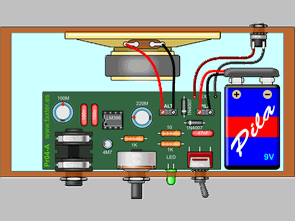
Low-power audio applications frequently used LM380N, crafted with LM386 amplifier circuits 3 TDA7052 amplifier circuit. the same for all the integrated master PCB prepared drawing seems a just some elements of the settlement changed by this different integrated circuits.
1W amplifier 2 .5W Amp circuits, standard power indicator led, power switch and dimming potentiometer input 6.3 mm jack plug. LM386: 5V–12V TDA7052: 5V. 12V LM380N: 9V …20V DC voltage.
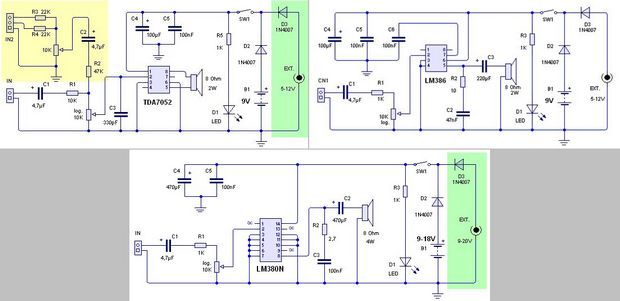
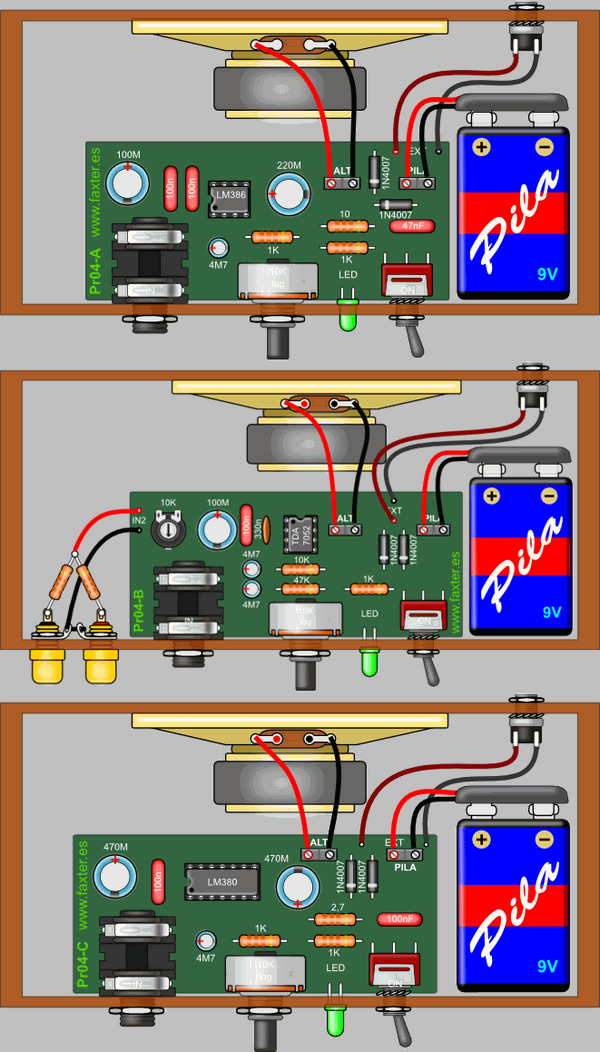
The author be portable and sound quality for the 9V battery connection has given information about the settlement plan prepared. For example, LM380N can work with high volume in order to get 9v only 20v battery instead of 2 x 9v battery can be obtained by connecting the battery voltage of the serial link serial-18v to increase batteries connected in parallel increases the power (batteries are going to be the same) can also be used instead of the proper voltage adapter battery
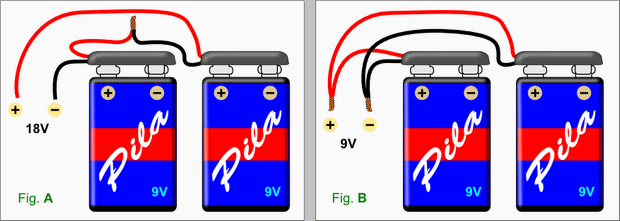
We can experiment with the battery connections to obtain different results.
In Fig. A, we see the connection of two 9V batteries connected in series .
With this configuration, we obtain a total voltage (VT) that is the sum of both batteries, that is, 18V. However, their lifespan will be equivalent to having a single battery, since their currents (I) do not add up.
In Fig. B we see the connection of two 9V batteries connected in PARALLEL .
With this configuration, we obtain a total current (IT), which is the sum of the current of both batteries, and therefore, they will last longer. However, the voltage is equivalent to having a single battery, since their voltages (V) do not add up… in this case, 9V.
In summary, if we have two 9V , 150mAh batteries , we get…
Connecting them in SERIES (Fig.A): V1 + V2 = 9 + 9 -> 18V and 150mAh .
Connecting them in PARALLEL (Fig.B): I1 + I2 = 150 + 150 -> 9V and 300mAh.
There is no problem with using a larger number of batteries as long as they are connected properly and everything explained above is observed.
Another interesting option would be to use rechargeable Ni-Mh or Ni-Ca batteries of about 1800-2000mAh. This will allow you, in addition to being able to recharge them when necessary, greater autonomy because they will take longer to run out.
To do this, we can use a container for 4 AA batteries (the traditional round ones) and place them all in series (these containers for 4 batteries usually come wired with a series connection).
It is important to keep in mind that rechargeable batteries are not 1.5V but 1.2V… therefore, 4 1.2V batteries in series will provide us with 4.8V (1.2 x 4). This voltage could be used for the first two circuits: Pr04-A and Pr04-B, although it would be more convenient to use 8 batteries in series and thus it would work for any of the 3 amps in this project. In this case, we would have a voltage of 9.6V (1.2 x 8).
The LM386, with its variants: LM386N-1, LM386N-3 and LM386N-4, is a small, low-power, acceptable-quality amplifier that can achieve a power output of around 700mW using a 9-volt power supply and any 8-ohm speaker or speaker cabinet that can handle at least 2W.
The TDA7052 is a small, low-power, high-quality amplifier that can achieve a power output of around 1W using a 9-volt supply and an 8-ohm speaker.
Note: the TDA7052-A and TDA7052- B variants are not compatible with this project. This integrated circuit has very good input sensitivity and is capable of handling small-value signals well. Therefore, we can use it to directly connect an electric guitar. For this specific case, I think it’s more advisable to use this IC instead of the LM386, since the latter isn’t as sensitive to being attacked by a guitar.
Furthermore, the TDA7052 provides slightly more output power with very similar battery consumption. It should be noted that this IC operates internally in bridge mode. For this reason, the speaker output is floating, and the speaker should never be connected to the circuit ground.
The LM380N is a small, low-power (although larger than the previous ones) and good quality amplifier with which we can achieve a power of around 2.5W using a 10-volt supply and an 8-ohm speaker.
Attention : the LM380N-8 variant (8-pin) is not compatible with this project .
source: faxter.es/Proyectos/Pr04Miniamplificadoresport%C3%A1tilesMiniGP/tabid/99/Default.aspx Alternatif link:
Headphone Amplifier TDA2822M
According to the size of the force is quite a popular TDA2822M amplifier IC is used in computer applications, as well as headphone amp seslendirmesinin connection according to the shape of the stereo or bridge connection with single channel can give higher audio.
The author used as a headphone amplifier 4 ohm 8 ohm or 32ohm speaker kullaklıklar says that good results with high-impedance headphones (100 Ohm, 600 Ohm) talks about the perfect functioning of the circuit, but with the sound level is lower than the
TDA2822M amplifier circuit
1W 2,5W Verstärker Schaltungen TDA7052 LM386 LM380N
Verstärker Schaltungen Low-power-audio-Anwendungen Häufig verwendet, LM380N, gestaltete mit LM386-Verstärker-schaltungen 3 TDA7052 Verstärker-Schaltung. das gleiche für alle, die integrierte master-platine vorbereitet Zeichnung scheint nur einige Elemente der Siedlung änderte sich durch diese verschiedenen integrierten schaltungen.
1W-Verstärker 2 .5W-Amp-schaltungen, standard-power-led-Anzeige, power-Schalter und DIMM-potentiometer-Eingang 6.3 mm jack-plug. LM386: 5V–12V TDA7052: 5V. 12V LM380N: 9V …20V DC Spannung.
What is the password to unzip files
Hello,
pass: 320volt.com