During the PCB manufacturing process at home, shaking the container holding the copper melting chemical accelerates the melting process.
An old computer DVD drive is disassembled, except for the cover and slide mechanism. The cover, gear system, and motor remain.
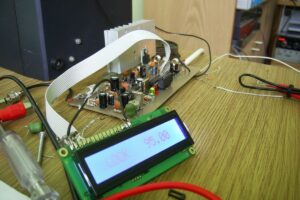
The PCB etching device is constructed using a motor control stage, an 8-pin PIC16F15313 microcontroller, and a DVR8833 motor driver module.
Two NO reed switches are mounted on the case, and two magnets are attached to the movable tray.
When one of the switches is closed by the magnet, the microcontroller reverses the direction of the tray.
There is also a potentiometer connected to an analog pin that controls the tray’s movement speed.
The vibration device is powered by a 12Vdc adapter. It operates with voltages between 6V and 12V.
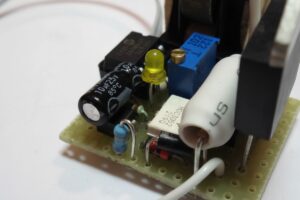
A 78L05 voltage regulator is provided for the microcontroller. The circuit is mounted on a perforated circuit board.
Be careful not to set the shaker too high when using it, as there is a risk of potentially dangerous liquid spills.
The source code files for the PIC16F15313 microcontroller are created in MPLAB X v6.08.
PCB Eluting Shaker PIC16F15313 DVR8833
Contents
In home PCB manufacturing, one effective way to shorten the copper etching/melting process is to shake the container holding the etching chemical in a controlled manner.
A simple vibrating shaker mechanism used for this purpose increases the contact of the acid with the copper surface, ensuring more homogeneous and faster etching.
A large version made with a profile was shared in the article on a simple shaking machine for printed circuit board acid pools. This PCB shaking device uses a DVDROM mechanism. Ideal for small to medium-sized PCBs.
PCB Eluting Liquid Shaker Test Video


The mechanical infrastructure of the device is derived from a DVD-ROM drive. Unnecessary parts such as the cover and slide were removed; the motor, gear set, and movable tray system were preserved and repurposed.
In the electronic control section, an 8-Pin PIC16F15313 microcontroller and a DVR8833 motor driver module are used. This configuration allows for software control of the motor’s direction and speed. The system produces sufficient and stable reciprocating motion for PCB etching.
Two normally open (NO) reed switches are fixed to the chassis, and two magnets are placed on the movable tray.
When the magnet triggers one of the reed switches during tray movement, the microcontroller reverses the motor’s direction, creating a continuous oscillating motion.
Additionally, the tray speed can be adjusted via a potentiometer connected to the microcontroller’s analog input.
Vibrating Shaker Circuit Diagram

The vibrating shaker is powered by a 12V DC adapter and can operate within the 6–12V range. A 78L05 linear voltage regulator is used to power the microcontroller. The entire circuit is mounted on perforated PCB.
It is important not to excessively increase the shaking speed during use. High speeds can increase the risk of splashing or spilling hazardous chemicals.
The control software for the PIC16F15313 microcontroller was developed in MPLAB X v6.08, and the source code files for the project are available.
Source diyfan.blogspot.com/2022/12/shaker-for-pcb-etching.html