Battery holders printed with a 3D printer are very useful parts in hobby electronics projects. Ready-made battery holders may not always be available in the desired size, cell count, or mechanical form. In such cases, designing a suitable battery holder or adapter for cylindrical batteries such as AA, AAA, C type, and 18650, or making use of ready-made STL files, is a practical solution.
In this article, four different battery holder and battery adapter designs shared on Thingiverse are examined.
The common point of the models is that although they look simple, they solve a real need in daily electronics work.
Some can be used directly as battery holders, while others can be used as carrying caps or size adapters.
For those who want to produce electronics project parts with 3D printing, small auxiliary parts such as SMD DIP adapter PCB drawings can similarly save time in the workshop.
1 Flexible Spring Battery Holder Design
Contents
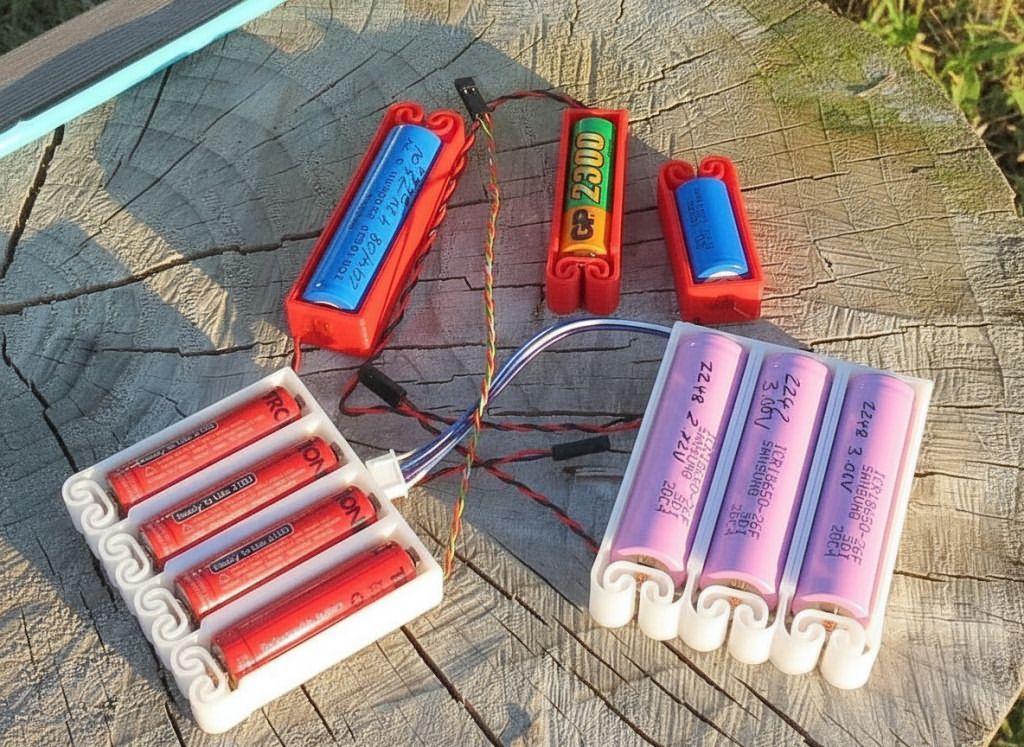
This design was prepared to produce flexible battery holders that can be printed on a 3D printer for cylindrical batteries of different sizes. Its most notable feature is that it uses a plastic flexible spring structure formed inside the body itself instead of a classic metal spring.
The logic of the design is quite practical: there is a flexible plastic spring on one side of the battery compartment. This spring flexes by about 1-2 mm, allowing the battery to be inserted and removed easily. Thus, a battery holder can be created entirely with 3D printing without installing a separate metal spring.
This structure is especially useful for single-cell battery holders or battery holders that can be customized according to different cell counts. If different battery sizes are frequently needed in electronics projects, the parametric design logic provides great convenience.
- It has an integrated plastic spring structure
- It does not require a metal spring
- A flexible structure is used for easy insertion and removal of the battery
- It can be adapted to different cylindrical battery sizes
- It is suitable for producing custom battery holders in hobby electronics projects
When printing this type of flexible part, slightly tougher and more flexible materials such as PETG or ABS may be preferred instead of PLA. Printing can also be done with PLA; however, the spring section may fatigue more easily in long-term use.
2 Adapter for Using an AA Battery Instead of a C Type Battery
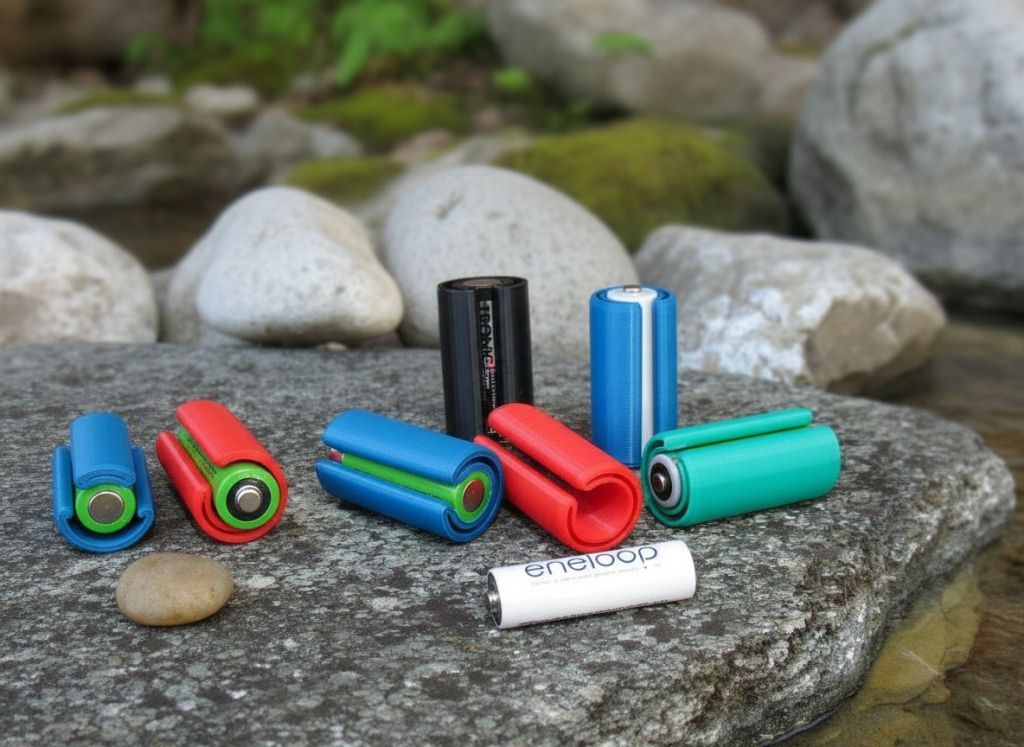
The second design is an adapter prepared to mechanically use AA-size batteries in devices that use C type batteries.
The purpose here is not to make an electrical converter, but to allow the AA battery to physically fit into the larger C battery holder.
AA and C batteries generally have the same nominal voltage value; however, the capacity and current delivery capability of a C type battery are usually higher.
Therefore, this adapter should be considered as a temporary or practical solution for low-current devices.
In motorized toys, high-current lamps, or devices that operate for a long time, the AA battery may be depleted quickly.
| Feature | Description |
|---|---|
| Purpose of use | Physically fitting an AA battery into a C type battery holder |
| Electrical conversion | None, it is only a mechanical adapter |
| Suitable use | Low-current devices and temporary solutions |
| Point to consider | The capacity of the AA battery is lower than a C battery |
This adapter can be useful when there is no C battery at home but there is an AA battery available. Still, it is not correct to mix a real C battery and an AA adapter in the same device. When batteries with different capacities are used together, the weak battery may be reverse-charged, creating a risk of leakage or damage.
For those interested in battery types and usage differences, the article about what an 18650 battery is also provides basic information on the lithium-ion cell side.
3 Flexible Battery Holders (2 and 3 Cells)
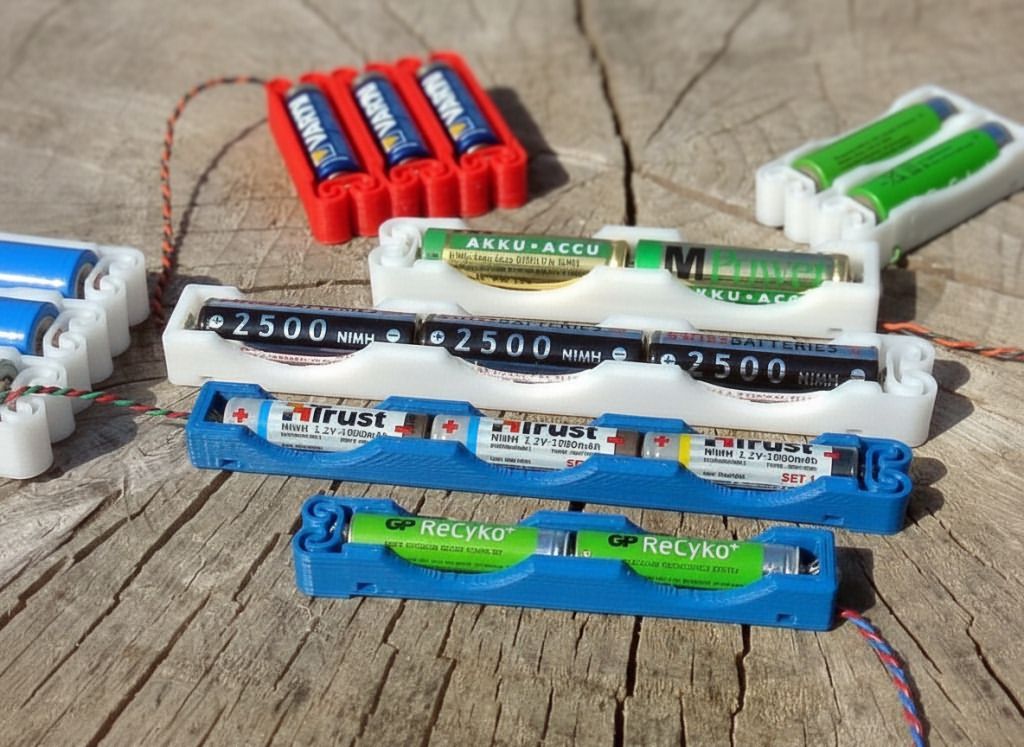
The third design is an improved version of the first flexible spring battery holder idea for multi-cell use.
Placing more than one battery in the same row creates some mechanical problems compared to a single-battery design.
Especially when spring pressure increases, it is possible for the batteries to lift upward from the connection point and try to come out of the holder.
For this reason, for 2-cell and 3-cell compartments, the battery must be held more evenly not only from the ends but also along the body.
The design was prepared to create multi-cell battery compartments for this need.
- It is suitable for 2-cell and 3-cell battery compartments
- It carries the flexible battery holder idea into multi-cell use
- It seeks a solution to the problem of batteries lifting upward from the middle point
- It can be used for small battery packs connected in series or parallel
- It can be integrated into custom project enclosures
In circuits using more than one battery, it is not enough for only the mechanical holder to be solid. The batteries must be of the same type, the same charge level, and preferably the same brand/model. In series-connected batteries, the weak cell can affect the behavior of the entire pack.
This type of battery holder can be used in small portable electronic circuits, LED lighting, sensor boxes, and prototype power supplies. After printing, the electrical connection must be completed by soldering a suitable conductive plate, spring, or wire to the battery contact points.
4 Protective Caps for AA, AAA, 18650 and Similar Batteries
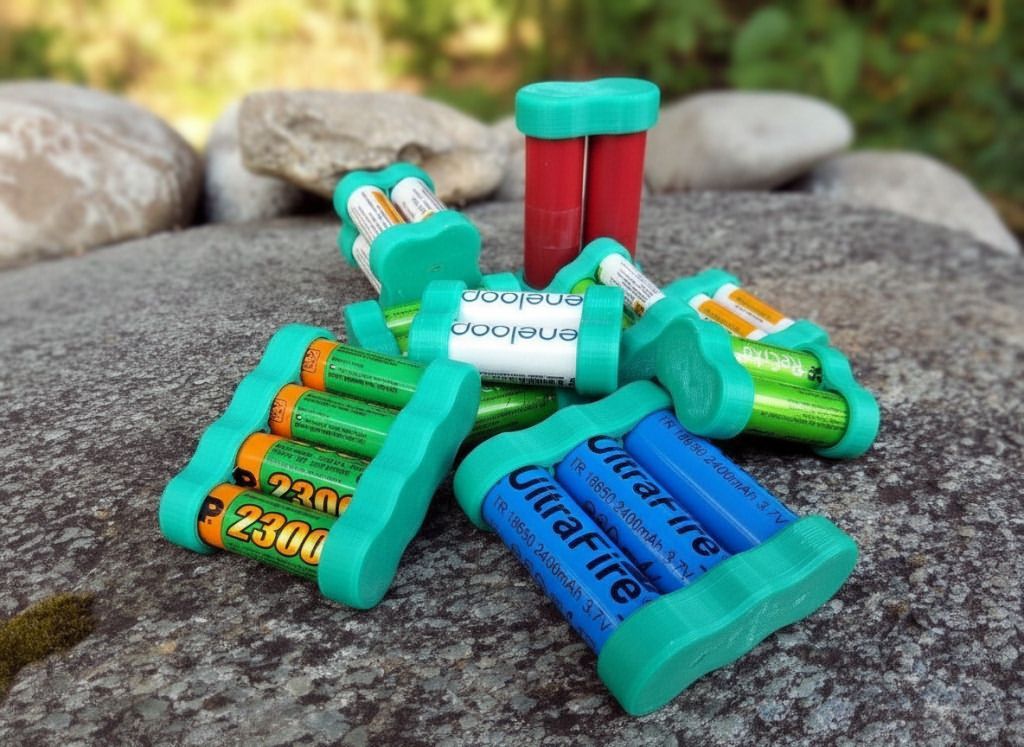
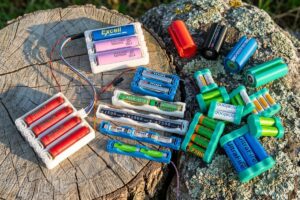
The fourth design is not a direct battery holder, but consists of caps used to protect the terminals of batteries while carrying or storing them. It is prepared for AA, AAA, 18650, and similar cylindrical batteries.
This type of cap is especially useful for those who carry spare batteries in a bag, toolbox, or drawer. Especially in 18650 lithium-ion batteries, contact of the terminals with metal parts can create a serious short-circuit risk. Even a simple plastic cap reduces this risk.
The goal of the design is for the cap to hold tightly even if there are small dimensional differences among batteries of the same type. Therefore, the flexible tab structure is important. The source states that it was printed with ABS and that the tabs work better with this material in terms of flexibility.
| Battery Type | Purpose of Use |
|---|---|
| AA | Protecting the terminals of spare penlight batteries |
| AAA | Preventing small batteries from scattering and making contact in a bag |
| 18650 | Reducing the short-circuit risk in lithium-ion cells |
| Other cylindrical cells | Use of a protective cap adapted according to size |
When carrying high-energy-density batteries such as 18650, they must definitely be stored in an insulated way. These caps alone do not replace a professional battery case; however, they are practical auxiliary parts that reduce the short-circuit risk. For safer carrying, batteries can also be stored in a plastic box.
For those dealing with battery safety and battery packs, the article about Li-ion, Li-Po, and LiFePO4 batteries also complements basic battery information.
Material Selection in 3D Printing
Parts such as battery holders and battery caps are not only decorative; they have mechanical tasks such as clamping, flexing, and carrying contact points. Therefore, material selection is important.
- PLA: Easy to print, but may not be long-lasting in spring-loaded and flexible parts
- PETG: Tougher and more flexible, often a good choice for battery holders
- ABS: Can provide advantages in flexible tab and cap structures
- Nylon: Durable and flexible, but more difficult to print
Metal contact points should not be expected from the 3D printed part itself. The print only serves as a mechanical carrier. For electrical conduction, nickel strip, copper foil, spring, brass plate, or suitable battery contacts should be used.
Points to Consider During Use
Battery holders coming out of a 3D printer may not be as standard and safe as ready-made commercial battery holders. Especially when working with lithium-ion batteries, the risks of short circuit, reverse connection, and overcurrent must be taken into account.
- The positive and negative direction of the battery must definitely be marked
- Open metal terminals must be protected on 18650 cells
- Batteries with different capacities should not be mixed in the same circuit
- In series-connected batteries, cells of the same type and similar charge level should be used
- Contact points should not be left loose
- In high-current circuits, it should be checked that the printed part does not heat up
Brief Evaluation
These four models on Thingiverse are good examples showing how useful a 3D printer can be in an electronics workshop.
Flexible spring battery holders meet the need for custom battery holders. The AA-C adapter offers a temporary solution in low-current devices.
Multi-cell compartments are useful for small battery packs. Battery caps increase safety especially when carrying spare batteries.
These designs can be printed and used directly; however, for the best result, the actual size of the battery used, print tolerance, material flexibility, and electrical contact method must definitely be checked.
1. It belongs to the “Flexing battery holders with integrated spring” design. thingiverse.com/thing:456900
2. It belongs to the “Yet Another AA to C Battery Adapter” design. thingiverse.com/thing:1719966
3. It belongs to the “Flexing battery holders with 2- and 3-cell compartments” design. thingiverse.com/thing:941081
4. It belongs to the “Battery caps for AA, AAA, 18650 and other cell types” design. thingiverse.com/thing:137582