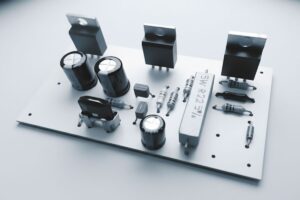
I don’t usually share power supplies that aren’t used in practice, but this project design is interesting, with a good power and voltage range. It’s a regulated power supply that allows reverse current flow. The supply can also function as an electronic load. The supply’s continuous output voltage is 0 to 50V, and the maximum continuous current setting is 0 to 5A.
The recommended input for the power supply is 7 to 50V DC. A minimum input voltage of 7V is required to ensure power supply operation. The input voltage of the recommended power supply should be 2V higher than the output voltage. The power supply acts as a standard regulated power supply or as an electronic load with adjustable voltage or current, depending on the behavior of the device (load, source).
The power supply is divided into two main parts. The first part is a linear voltage or current source that enables the power supply to operate in the first quadrant. The second part is an electronic load that operates in the second quadrant. Both parts have their own voltage and current regulators. Output quantity sensors are common to both parts of the power supply.
Electronic Load 0-50V 0-5A Power Supply Circuit Diagram

Thermal Protection of Power Components
Power components, especially the T2 IRFP240 MOSFET transistor that forms the electronic load, become hot during operation. Therefore, protection against overheating must be ensured. If the IRFP240 transistor temperature exceeds 60°C, the fan will activate. If the IRFP240 transistor continues to heat up and reaches the critical temperature of 140°C, the protection will turn on the transistor, preventing further overheating.
A KTY81-210 resistive temperature sensor (min. 1980 ohms – max. 2020 ohms) is used to detect the temperature. It is connected as a voltage divider with a resistor supplied with a 2.5 V voltage reference. An open-collector LM393 comparator is used to evaluate the critical temperature. The voltage from the temperature divider and the temperature sensor is applied to the inverting input of the LM393 comparator.
The non-inverting input is supplied with a voltage equal to the voltage across the resistor divider at the temperature at which the LM393 comparator will turn on. This voltage is obtained from another voltage divider, also supplied with a voltage reference. An open-collector comparator is also used to evaluate the temperature at which the fan will be turned on. The only difference is the connection of the comparator inputs.