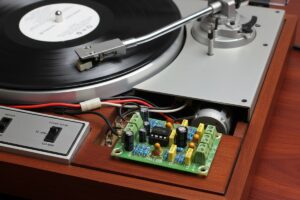
The RIAA gramophone preamplifier circuit is a stereo preamp circuit designed to raise the low-level signal of turntables with magnetic cartridges to a level suitable for AUX, line-in, mixer, or computer audio inputs. The circuit uses a low-noise NE5532 dual opamp; the feedback network applies the RIAA equalization used in vinyl records.
Why Is an RIAA Gramophone Preamplifier Needed?
Contents
- 1 Why Is an RIAA Gramophone Preamplifier Needed?
- 2 Basic Structure of the Circuit
- 3 Operating Principle of the Circuit
- 4 Supply Line and Noise Control
- 5 Technical Specifications
- 6 Component List
- 7 Assembly Sequence and Connections
- 8 Points to Consider During Setup
- 9 First Test and Check
- 10 Can Another Opamp Be Used Instead of the NE5532?
- 11 Suitable Usage Areas
The output of a gramophone with a magnetic cartridge is not strong enough to be connected directly to the AUX input of a normal amplifier.
The cartridge output is low-level and its frequency balance is not flat. During vinyl recording, low frequencies are attenuated and high frequencies are boosted by a certain amount.
If the opposite correction is not applied during playback, the sound has a thin, bass-weak, and unnatural character.
An RIAA preamplifier performs two tasks at the same time: it increases the signal level and corrects the frequency response according to the RIAA curve.
Therefore, the gramophone output should not be treated in the same way as a simple microphone amplifier or tone control circuit.
As much as the gain of the circuit, the resistor and capacitor values in the feedback network also have a direct effect on sound quality.
Basic Structure of the Circuit
The gramophone preamp circuit has a two-channel structure. The left channel is built with the IC1A opamp section, and the right channel is built with the IC1B opamp section.
Since the NE5532 IC contains a dual opamp, the stereo application is completed with a single IC. The circuit is designed to operate with a single DC supply; therefore, biasing is applied at the input stage so that the signal fits within the opamp operating range.
| Section | Function |
|---|---|
| Input coupling | Receives the AC audio signal from the gramophone and blocks DC components. |
| Bias network | Moves the opamp input to the proper DC operating point in single-supply operation. |
| NE5532 opamp stage | Amplifies the low-level cartridge signal. |
| RIAA feedback network | Corrects bass and treble frequencies according to the RIAA curve. |
| Output coupling | Blocks the DC component from the amplified audio signal and provides an output close to line level. |
| Supply filters | Reduce ripple and high-frequency noise on the supply line. |
The NE5532 is a low-noise opamp frequently used in audio applications. For different applications made with the same IC, the NE5532 hi-fi headphone amplifier circuit can also be examined. In the RIAA preamp circuit, the opamp is not only a gain element; it operates together with the feedback network that determines the frequency characteristic.
Operating Principle of the Circuit

Input Stage and Biasing
C13 in the left channel and C14 in the right channel are used as input coupling capacitors.
While these capacitors carry the audio signal from the gramophone cartridge to the opamp input, they prevent any possible DC component on the input side from entering the circuit.
The R11-R13 and R12-R14 resistors determine the DC operating level at the input point.
In single-supply opamp circuits, the negative half-cycle of the signal cannot go directly below ground.
Therefore, the opamp inputs are placed on a suitable DC reference. If this reference is not established correctly, clipping, low audio level, or serious distortion may occur at the output.
RIAA Feedback Network
The main character of the circuit is determined by the feedback network around R3, R5, R7, C1, and C3.
In the right channel, R4, R6, R8, C2, and C4 perform the same function. These components create frequency-dependent feedback, so the opamp gain is not kept constant; different gain behavior is provided at low, mid, and high frequencies.
In RIAA equalization, low frequencies must be brought to the proper level, while high frequencies must be balanced according to the vinyl recording characteristic.
Resistor or capacitor tolerances can have more effect here than an ordinary wiring error.
Especially for C1-C2, C3-C4, and the feedback resistors, choosing low-tolerance, high-quality components is useful for channel balance and tonal accuracy.
Effect of the 100 pF Capacitors at the Input
C7 and C8 are used around the input to limit high-frequency interference.
When the gramophone cable is kept long or when there are strong RF sources nearby, unwanted high-frequency signals may mix into the opamp input.
These small-value capacitors help the input operate more calmly without directly disturbing the upper limit of the audio band.
Output Stage
C9 and C10 are output coupling capacitors. Since the opamp output may have a DC offset caused by single-supply operation, these capacitors pass only the AC audio component of the signal to the outside. The L-OUT and R-OUT terminals should be connected to the AUX, line-in, or mixer input of the amplifier.
The output of this circuit is not suitable for directly driving a speaker. A separate power amplifier is required for speaker connection.
If line-level tone shaping will be performed, an additional stage such as a stereo tone control circuit can be used after the RIAA preamp output.
Supply Line and Noise Control
The circuit is specified to operate with a single supply in the 5-15V DC range. Current consumption is approximately 10 mA.
For sound quality, the cleanliness of the supply voltage is as important as its value. Cheap switching adapters or poorly filtered supplies can create hum, background noise, and unwanted interference in the treble region.
The C5 100 uF and C6 100 nF capacitors are used for filtering the supply line. While the large-value capacitor reduces low-frequency ripple, the 100 nF capacitor suppresses faster high-frequency noise components.
The filtering around R9-C16 and R10-C15 helps keep the input bias line cleaner.
In gramophone preamp circuits, the power supply, signal cable, and chassis arrangement should be considered together.
Even if the supply is clean, a long unshielded input cable or incorrect grounding can produce serious hum.
To see similar audio applications together, other preamplifier and filter circuits in the audio circuits archive can also be compared.
Technical Specifications
| Feature | Value / Description |
|---|---|
| Circuit type | Stereo RIAA gramophone preamplifier |
| Suitable cartridge type | Analog gramophone with magnetic cartridge |
| IC | NE5532 dual opamp |
| Number of channels | 2 channels, left and right |
| Supply | 5-15V DC single supply |
| Current consumption | Approximately 10 mA |
| Output connection | AUX, line-in, mixer, or computer audio input |
| Frequency equalization | RIAA characteristic |
| Channel separation | Given as 110 dB |
| PCB size | 36 x 52 mm |
Component List
| Reference | Value |
|---|---|
| R1, R2 | 820R |
| R3, R4 | 22k |
| R5, R6 | 220k |
| R7, R8 | 1k |
| R9, R10 | 18k |
| R11, R12 | 100k |
| R13, R14 | 120k |
| C1, C2 | 3.3nF |
| C3, C4 | 15nF |
| C5 | 100uF |
| C6 | 100nF |
| C7, C8 | 100pF |
| C9, C10 | 1uF |
| C11, C12 | 10uF |
| C13, C14 | 4.7uF |
| C15, C16 | 22uF |
| IC1 | NE5532 |
Since the RIAA network directly affects the sound character, metal film types should be preferred for the resistors.
Low-tolerance and low-leakage components also give better results for the capacitors.
If the orientation of electrolytic or tantalum capacitors is connected incorrectly, the circuit may not operate, noise may increase, or the capacitor may be damaged.
Assembly Sequence and Connections

Starting assembly with low-profile components is the cleanest method. First the resistors, then the small ceramic or film capacitors, then the electrolytic/tantalum capacitors, IC socket, and terminal blocks can be installed. If the NE5532 will be soldered directly, care should be taken not to overheat it; using a socket is more practical for both testing and possible replacement.
- The left channel signal of the gramophone is connected to the L-IN input.
- The right channel signal of the gramophone is connected to the R-IN input.
- The shields of the signal cables and the common chassis are connected to the GND terminals.
- A 5-15V DC supply is applied to the V+ and V- terminals.
- L-OUT is the left channel output and goes to the left line input of the amplifier.
- R-OUT is the right channel output and goes to the right line input of the amplifier.
If the gramophone has a metal chassis or grounding wire, it should be properly connected to the GND point of the circuit.
When the ground connection is not made, 50 Hz mains hum may become noticeable.
However, if multiple devices in the system are connected to each other through the chassis, a ground loop may occur; in such a case, the connection points should be checked one by one.
Points to Consider During Setup

Input Cables Should Be Short and Shielded
Since the cartridge output is low-level, the input cable is very likely to behave like an antenna.
The L-IN and R-IN connections should be kept as short as possible, and shielded audio cable should be used.
The cable shield should be connected only to the proper GND point; random chassis contacts may increase hum.
Using a Metal Enclosure Improves Sound Quality
Placing the circuit in a metal enclosure reduces interference, especially when used near a mains transformer, adapter, computer, or wireless devices.
The metal enclosure should be connected to the circuit GND line in a controlled way. If a plastic enclosure is used, the quality of the input and output cables becomes more critical.
It Should Be Connected to the Line Input, Not the Phono Input
The output of this circuit should be fed to the AUX or line input of the amplifier.
If a signal that has already undergone RIAA equalization is connected again to a phono input, it passes through the RIAA process a second time and the sound balance is distorted.
If the amplifier has a dedicated phono input, this circuit may not be needed.
First Test and Check
It is safe to use the power supply with current limiting during the first startup. The circuit should draw approximately around 10 mA.
If the current is noticeably high, the supply polarity, NE5532 orientation, polarity of the electrolytic capacitors, and solder bridges should be checked.
| Symptom | Possible Cause |
|---|---|
| No sound at the output | Incorrect input/output connection, reverse supply, incorrect opamp orientation, or broken solder joint |
| Sound comes from only one channel | L/R connection error, cold solder joint in the related channel, or faulty capacitor |
| Heavy hum present | Unshielded input cable, incorrect GND connection, poorly filtered adapter |
| Sound is muddy or excessively bright | Incorrect value or soldering error in the RIAA feedback components |
| Sound is distorted | Insufficient supply, incorrect bias point, output connected to the wrong input |
If an oscilloscope is available, a very low-level sine signal can first be applied to the input for testing.
Applying a directly high-level signal is misleading, because the circuit is designed for signals at magnetic cartridge level.
If a signal generator is used, the input level should be kept low and the output should be checked for clipping.
Can Another Opamp Be Used Instead of the NE5532?
The NE5532 is a suitable choice for this circuit; it provides the advantages of low noise, good channel separation, and widespread use in audio applications. Some dual opamps with the same pinout can be tried, but not every opamp gives the same result in this circuit.
Although JFET-input opamps such as TL072 may work in some applications, the noise and character may be different.
Audio-focused alternatives such as OPA2134 or LM4562 can give higher-quality results, but supply voltage, stability, and socket compatibility should be checked.
The first point to check when changing the opamp is pin compatibility.
Then the recommended supply range, single-supply operating behavior, and output swing limits should be examined.
Using a more expensive opamp alone does not solve incorrect grounding or noisy supply problems.
Suitable Usage Areas
The RIAA gramophone preamplifier is useful in amplifiers without a built-in phono stage.
It is suitable for setups such as recording old turntables to a computer, connecting an analog record player to the line input of a mixer, or using an external phono preamp in a hi-fi system.
Since the circuit draws low current, it can be operated with a small regulated adapter; however, the supply and enclosure should not be neglected for sound quality.
When assembled correctly, the circuit raises the magnetic-cartridge gramophone signal closer to line level and provides a more balanced listening experience with RIAA equalization.
For the best result, quality connection cable, low-noise supply, proper grounding, and correct component values in the feedback network should be considered together.
Note: The RIAA preamp PCB drawing was copied from the drawing in the PDF file using the Sprint layout 6 program. It was checked according to the schematic and I could not see any problem, but it has not been tested.
Source: arlisklep.pl/files/ARLI/AR188.pdf