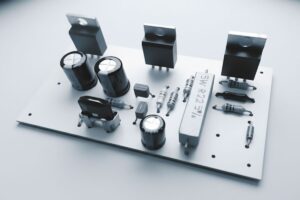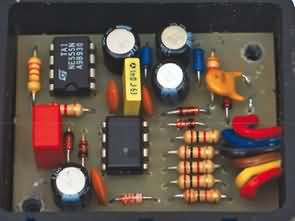
A simple current direction indicator device for monitoring current balance in older vehicles, battery chargers, UPS backup power supplies, or differential devices.
A two-color LED is used for the current direction indicator. Current flow in one direction illuminates the green LED, while current flow in the other direction illuminates the red LED. When there is no current flow, both LEDs are active and illuminate orange. This simple indicator can be useful for estimating current balance in automotive vehicles where a lack of charge/discharge information can lead to starting problems.
These problems can be caused by reasons such as alternator drive belt slippage, battery wear, damaged alternator diodes, etc. The indicator can also be used for visually monitoring the operating status of UPS battery chargers.
How does the circuit work?

The positive supply voltage is connected to point J1, and ground to point J2. Diode D1 protects the circuit against reverse voltage polarity. R1 and D3 limit the voltage to +9 V. To enable the NE5532 operational amplifier to operate at input voltages lower than ground potential, a simple negative voltage converter based on the NE555, operating as a generator with a frequency of approximately 20 kHz and a duty cycle of approximately 50%, is used. Elements C7, C8, D8, and D7 form a charge pump, and the R8 and D9 circuit stabilizes the negative voltage at -3.3 V.
For the measuring resistor, a battery grounding cable is used, connected to the J2 and J3 solder pads of the circuit via wires, and then to the inputs of the NE5532 operational amplifiers, which operate as voltage comparators via open feedback loops through R2 and R4, i.e., without hysteresis.
The NE5532 has protective diodes at its inputs, but the circuit also uses diodes D2, D4, and D6 to provide additional protection against potential surges with amplitudes greater than the supply voltage. If the voltage at the non-inverting input is higher than the voltage at the inverting input, the output voltage will be close to the positive terminal of the supply.
Conversely, the output voltage will be close to the negative terminal of the supply. The measurement inputs J2 and J3 are connected to the amplifier inputs to form a “differential comparator.” When the voltage at J2 is higher than the voltage at J3, the red LED will light up. When the voltages at J2 and J3 are approximately equal, the LED will light up orange, as both LEDs will light up.
The high gain of the NE5532 circuit inevitably leads to increased noise and interference at low DC shunt voltages, resulting in a square wave at the output. While this is generally a negative effect, it is desirable here and resembles a PWM waveform, observable by operating LED D5 in a dark room.

Source: sklep.avt.pl/avt3039.html