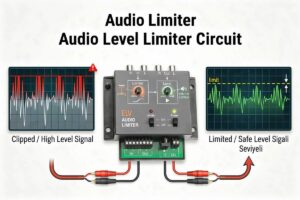
Sudden increases in sound level can sometimes be not only disturbing, but also risky for speakers and connected audio equipment. The Audio Limiter is a practical analog sound limiter solution that comes into play exactly at this point. This circuit is designed to limit the signal level in the analog audio line so that it does not exceed a certain threshold value.
Its purpose of use is quite clear: to reduce sudden sound jumps that may occur while listening to music, watching television, or using a radio. Especially in systems with active speakers, power amplifiers, TV soundbars, or analog audio inputs, the aim is to prevent sound increases above the set level.
The supply voltage of the device is in the 12-24V DC range. The maximum current consumption is approximately 50 mA. The input level is specified as a maximum of 10 VSS (3.5 Vrms), and the output level as a maximum of 8 VSS (2.8 Vrms). In addition, the gain can be adjusted between -12 dB and +6 dB, while the limiter threshold can be adjusted in the 0.3-2 Vrms range.

What Does a Limiter Do?
Contents
- 1 What Does a Limiter Do?
- 2 Technical Specifications
- 3 Operating Principle of the NJM2761 Limiter IC
- 4 Characteristic Curve and Threshold Point
- 5 Circuit Structure
- 6 What Does the LED Indicator Do?
- 7 Output Stage and OTA Structure
- 8 What Is OTA? Why Is LM13700 Important?
- 9 Power Supply Section and Protection Structure
- 10 Assembly and Installation Information
- 11 Application Areas
The word limiter already directly describes its function: to set a limit. What is limited here is the amplitude of the audio signal. In practice, this means that the sound level is not allowed to increase further after a certain point. The signal below this threshold value is not affected. When the sound level exceeds this defined limit, the limiter is activated and prevents the output from increasing further.
This type of structure can be quite useful in daily use. For example, it can be used for speaker protection. When the limiter is connected between the preamplifier and the power amplifier, the set sound level is not exceeded, and the possibility of overloading the speakers is reduced.
Another usage scenario is related to advertisement sounds on a TV or satellite receiver. It is known that in some broadcasts, the sound level during commercial breaks feels higher than the normal program. In such cases, a limiter added to the analog audio line can suppress sudden increases and provide a more balanced listening experience.
However, there is an important point here: this method can be applied only on an analog audio connection. It is not possible to insert it in between and intervene in the same way on digital connections such as HDMI.
Technical Specifications
- Supply voltage: 12-24 VDC
- Current consumption: maximum 50 mA
- Maximum input level: 10 VSS / 3.5 Vrms
- Maximum output level: 8 VSS / 2.8 Vrms
- Gain adjustment: -12 dB to +6 dB
- Limiter range: 0.3-2 Vrms
- Frequency response: 15 Hz – 35 kHz (-3 dB)
- THD: maximum %0.3
- Maximum cable length: 5 meters
- Operating temperature: -10°C to +55°C
- Storage temperature: -40°C to +85°C
- Dimensions: 89 x 26 x 99 mm
- Weight: 100 grams
Operating Principle of the NJM2761 Limiter IC
At the center of this circuit is the NJM2761 IC. The operating principle of the circuit is basically based on the automatic gain control principle. The signal taken from the output is rectified to obtain a DC control voltage. This control voltage affects the electronic adjustment structure inside the circuit, and the gain at the input is reduced accordingly.
The resistor connected to the Sense pin in the circuit determines at which level the limiter will be activated. In other words, the limiter threshold is defined here. The capacitor connected to the INT pin determines the response characteristic. As the capacitor at this point becomes larger, the circuit recovers more slowly. In other words, after the sound level drops, the release time of the limiter becomes longer.
The important distinction here is this: the first response of the circuit to a sound increase, that is the attack time, is already kept short. Because sudden sound increases must be suppressed as quickly as possible. The main behavior that changes is the release time. In this way, smoother control can be achieved without processing the signal in a very harsh and artificial way.
Characteristic Curve and Threshold Point
When the behavior of the limiter is examined graphically, its operating principle becomes clearer. As the input level initially increases, the output also increases linearly. In other words, the limiter is not yet active. However, when the input level reaches the adjusted threshold point, the output no longer continues to rise in the same way and begins to remain constant.

This break point indicates the threshold at which the limiter becomes active. By selecting different threshold values, it can be adjusted at which sound level the system will intervene. This feature allows the device to be adapted to different scenarios such as both speaker protection and reducing disturbing sudden sound increases.
Circuit Structure

Stereo input signals are delivered to the NJM2761 inputs through coupling capacitors and series resistors. The Transil diodes on the input line provide protection against overvoltage pulses. The limiter threshold is adjusted with the help of a trimpot. In addition, the limiter function can be completely disabled with a switch.
The control voltage formed on the INT pin is filtered with a capacitor. Although 22 nF is recommended in the manufacturer’s application at this point, 47 nF was used in the circuit to obtain a slower and smoother regulation characteristic. In other words, the aim is to make the sound suppression behavior more natural.
What Does the LED Indicator Do?
A comparator in the circuit monitors the voltage on the INT line. When this control voltage exceeds approximately 0.3 V, the LED becomes active. In this way, it can be visually understood whether the limiter is activated or not.
This detail is quite useful in operation. Especially in applications such as TV advertisement sound limiting, it may be desired for the limiter to be slightly active even at the normal sound level. While adjusting the trimpot, the user can easily see from the red LED at which point the circuit enters the limiting range.
Output Stage and OTA Structure
After the limiter stage, an amplifier section has been added to the circuit. This section is prepared with an OTA, that is, a transconductance amplifier structure. The structure mentioned here is slightly different from classic op-amps. OTAs are known not as voltage-controlled, but more as an current-controlled gain structure.
The important advantage of this approach is that the gain adjustment of the two stereo channels can be made together with a single trimpot. In this way, crackling, contact deterioration, or long-term noise problems that may be caused by mechanical potentiometers placed directly in the signal path are reduced.
The gain adjustment is made with R23. The control current provided through this trimpot drives the OTAs and changes the gain of both channels at the same time. The adjustable gain range is between -12 dB and +6 dB. The output signals are also transferred to the output sockets and terminals through coupling capacitors.
What Is OTA? Why Is LM13700 Important?
The OTA concept used in this circuit is interesting from an electronics perspective. An Operational Transconductance Amplifier, that is, a transconductance amplifier, is a structure that converts the voltage difference at the input into output current. When a suitable resistor is connected to its output, this current can be converted back into voltage.
With these types of amplifiers, current-controlled analog filters, voltage-controlled amplifiers, and modulator circuits can be built. Here, LM13700 is given as a typical example. Since the LM13700 also includes a Darlington output structure, it can be used in many analog audio applications. It is a very well-known IC especially in VCA, that is, voltage-controlled amplifier applications.
Power Supply Section and Protection Structure
The circuit operates with 12-24V DC. The power supply can be provided both through the DC jack and through the terminal block. There are several important protection and regulation sections at the power input.
- PTC fuse provides protection by increasing its resistance under overload.
- T1 transistor is used for reverse polarity protection.
- IC4 regulator generates the stable 10V supply required for the circuit.
- IC2B is connected as a voltage follower and creates the 5V level required for the OTA section.
This structure helps both the limiter IC and the output stage operate more stably.
Assembly and Installation Information
The circuit board is supplied with SMD components pre-installed. This provides great convenience, especially for those who do not want to deal with small SMD parts. On the user side, mainly the through-hole assembly components need to be placed.
During assembly, it is sufficient to follow the classic rules. The parts are soldered according to the placement plan, and excess lead ends are cut. Since the voltage regulator is placed horizontally, its legs are bent 90 degrees, mounted, and fixed with a screw.
It is stated that the total height of the LEDs from the board surface to the tip should be 18 mm. LED polarity must also be observed. The long leg is the anode, that is, the positive terminal. In the final stage, the sockets, trimpots, and switch are installed. After the board is checked, it is placed into the enclosure and fixed.
Application Areas
This limiter circuit can be used for several different purposes:
- It can be connected between the preamp and power amplifier for speaker protection.
- It can be used after the mixer output to limit the maximum level.
- It can be placed between a TV or satellite receiver and a device with an analog audio input to reduce advertisement sounds.
- It can be used at the input of an active speaker or soundbar to suppress sudden sound jumps.
When used between a satellite receiver and a television, it is recommended to adjust the limiter so that it is active even at the normal sound level. This situation can be monitored through the red LED. General level matching can also be made with the Level adjustment. Thanks to the slow and controlled regulation characteristic of the circuit, an attempt is made to prevent the sound from being heard as overly artificial or distorted.
Source: de.elv.com/p/schuetzt-ohren-und-equipment-audio-limiter-al100-P200722/