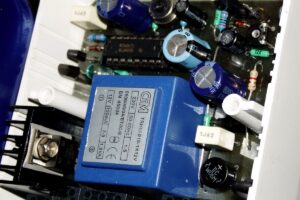
The device is designed to control the solenoids of the loader bucket’s hydraulic system valves. The bucket control is hydraulic and consists of a valve system controlled by solenoids A-B-C-D. Furthermore, the solenoids are controlled sequentially by the joystick interface, depending on the joystick angle in the selected direction. The system has been continuously developed and developed to its final form. In the latest version, all levels are integrated onto a single PCB. SMD and DIP components have significantly reduced the PCB size. The program used is DipTrace.
Joystick direction “forward-backward” corresponds to raising and lowering the bucket, while joystick direction “left-right” corresponds to the bucket’s angle. In this case, joystick direction “forward” corresponds to activating solenoid A, while “backward” corresponds to activating solenoid B, “left” to C, and “right” to D. The crosswise joystick lever’s AC solenoids control the “left, forward” and “right, forward” (AD), “left-backward” (BC), and “right-backward” (Right-forward) functions.
The movement speed of the loader’s bearing rods and the rate at which the bucket angle changes are regulated by the tilt angle of the control lever in specific directions, which in turn is determined by the rotation angle of the standard control lever potentiometers. The neutral position of the control lever corresponds to the center position of the potentiometer sliders, one of which is “off-balance” (relative to the center of the resistive rail) when the control lever is moved along the X-axis, and the other along the Y-axis.
The force applied to the valve by the solenoid is determined by the magnitude of electromagnetic induction, which in turn depends on the magnitude of the direct current flowing through the solenoid winding and, consequently, the voltage applied to the solenoid winding. However, direct current control is quite energy-intensive and involves significant electrical power losses in the control elements (each solenoid consumes approximately 750 mA when supplied with +24 V), leading to overheating. Therefore, when designing the interface circuit, a pulse width version of the solenoid winding current control was selected.
Accordingly, the pulse width should be determined by the angle of the control lever in the selected direction. Experiments with the solenoids of a specific electric forklift found that electromagnetic induction can be easily controlled with a pulse width sequence with a repetition rate ranging from hundreds of hertz to several tens of kilohertz. It is clear that all solenoids have different parameters, and the pulse repetition frequency (unless specified for a specific type) must be selected individually to avoid potential losses. Furthermore, for example, the standard control circuit for the solenoids of the CASE CX210B excavator hydraulics has a pulse sequence of 19.5 kHz at the PWM output, while the recommended TL494 PWM frequency for the PPCD04 solenoids used in the excavator hydraulic system is 100 Hz.
The TL494 integrated circuit was selected as the least expensive option, allowing for simple circuit solutions for controlling the PWM analog signal.
Source: cxem.net/promelectr/promelectr52.php