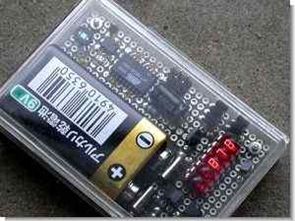
Lux metre devresi atmel attiny26-16 mikrodenetleyici üzerine kurulu led display üzerinde lux değerini görüntülüyor ledler 2sk1061 mosfetler ile sürülmüş. İlginç bir uygulama tüm kaynak dosyalar (pcb, şema, kod) paylaşılmış ayrıca devrenin kalibrasyon bilgileride verilmiş

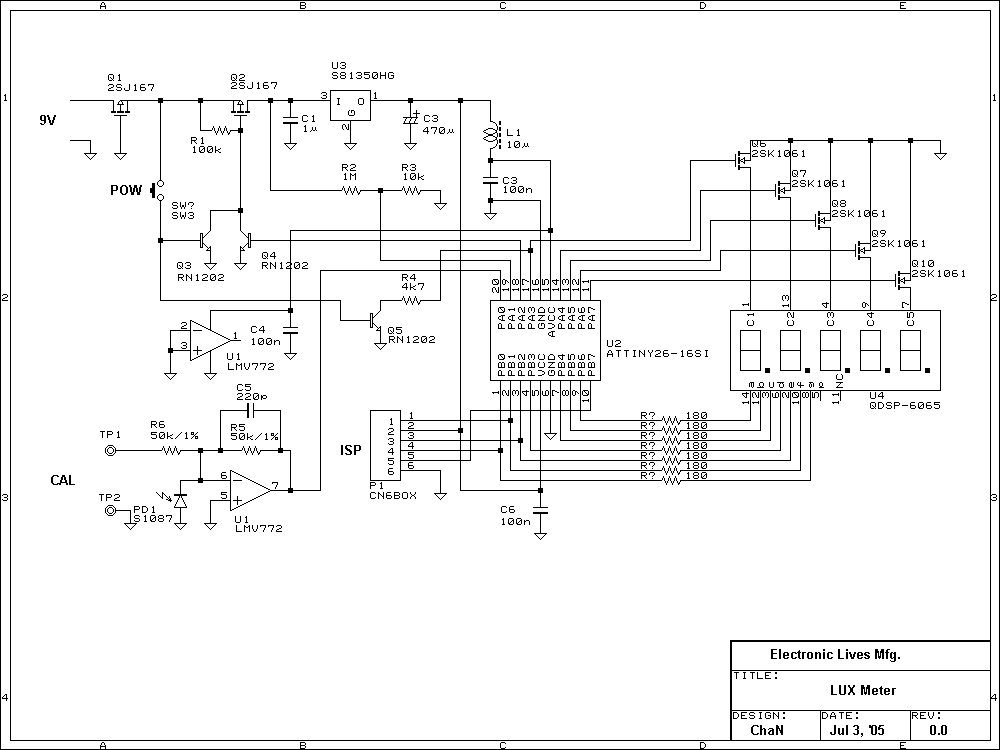
Lux metre devre şeması;
Lux Metre genellikle aydınlatmayı ölçmek için kullanılır. Aydınlatma, bir yüzey alanına ışık akısı seviyesinin nasıl düştüğüdür. Işık akısı, ışıma akısının (ışık gücü) insan gözünün görünür spektrum üzerindeki göreli hassasiyetine bölünmesiyle tanımlanan görünür bileşendir. Bu, Lux’ın insan gözünün algıladığı ışık seviyesine uygun olduğu anlamına gelir.
Bununla birlikte, sıradan silikon foto diyotun spektrum tepkisi ile insan gözünün spektrum tepkisi arasında bir fark vardır, lüks metre için kullanılamaz. Aydınlatma sensörü için bazı foto diyotlarda, spektrum yanıtını düzeltmek için pencerede bir renk dengeleme filtresi bulunur.
Donanım
Foto diyot, kısa modda kullanıldığında giriş ışık gücüyle iyi orantılı olan ışık akımı verir. Bu lüks metrede çıkış akımı IV dönüştürücü ile gerilime çevrilir, mikrodenetleyici tarafından yakalanır ve lüks cinsinden gösterilir. Devre Şeması’ndaki ppamp U1, IV dönüştürme devresi gibi davranır ve dönüştürme oranı, R5 geri besleme kaydına göre 50mV/µA olur. C5 kondansatörü düzeltme elde etmek içindir, foto diyotun Ct’sini iptal eder (yaklaşık 200 pF). Bu durumda, yüksek frekanslı sinyale gerek olmadığı için 220 pF yerine daha büyük kapasitans iyi olabilir.
Lüks metre, 9V pil ile çalışır. Pil alanını en aza indirmek için, pil çıtçıtı yerine nikel kaplı bakır fosfor alaşımından yapılmış iki adet yay ile temas ettirilir. Ancak anti-ters girişli bir yapı değildir, herhangi bir koruma devresine ihtiyaç vardır. Q1, seri diyot gibi voltaj kaybı olmayan ters giriş koruyucusudur. Q2, Q3 ve Q4 ile güç tutma devresi oluşturan bir ana şalterdir.
U4, HP’den 7 segmentli bir LED ekrandır. 14 pinli bir DIP paketine yerleştirilmiştir. Kullanışlı ekipmanlar için kullanışlıdır ancak az güç tüketmediği için pille çalışmaya uygun değildir.
Lux Metre Yazılım
Ürün yazılımının ana işlevi, yalnızca AD dönüştürücü ile sensör çıkışını yakalamak ve bunu LED ekranda görüntülemektir. AVR’nin yerleşik AD dönüştürücüsü 10 bit çözünürlüğe sahiptir ancak endüstriyel ölçüm sistemi için biraz yetersizdir. AD dönüştürücü birimi, çoklayıcı ile AD dönüştürücü arasına yerleştirilebilen bir kazanç yükselticisine sahiptir. Bu, giriş kazancını otomatik olarak değiştirerek çözünürlüğü iyileştirmeyi sağlar. Bu işlevi uygulamak için, girişi 20 kazançta yakalayın, taşma meydana gelirse, 1 kazançta tekrar yakalayın. Sonuç olarak, göreceli çözünürlüğü düşüren küçük giriş çözünürlüğünde çözünürlüğü iyileştirebilir. Maksimum ışık girişi yakl. 0 ila 2,56 V AD giriş artışı nedeniyle 30000 lux.
AD çeviriciden gelen sonuç, lux cinsinden LED ekrana bir kalibrasyon değeri ile çarpılır. Düşük pil durumunda LED yanıp sönecektir.
Güç anahtarı, gücün kendisini kontrol etmek için mikrodenetleyici tarafından tutulur. Bu, gücü kapatmayı unutmayı önlemek için kullanışlıdır. Bu lüks ölçer, gücü 60 saniye içinde kapatır.
Kalibrasyon
Çoğu durumda herhangi bir referans ışık kaynağı mevcut olmayacaktır. Lüks ölçeri kalibre etmek için yalnızca veri sayfasına güvenmemiz gerekir. S1087 veri sayfasına göre kısa akım Isc = 0.16µA/100lux şeklindedir. 1250 lükste 2µA olur. Test pimine (TP1) -100 mV uygulandığında, foto diyotta 1250 lux’e eşdeğerdir ve IV dönüştürücü 100 mV çıkış verecektir.
Kalibrasyonu gerçekleştirmek için birkaç kΩ direnci ile ISP pimlerini bağlayın, gücü açın ve referans girişine göre kalibre edilecektir. TP1’de SCK-GND ve -100 mV olduğunda düşük aralık kalibre edilir, TP1’de MOSI-GND ve -1 V olduğunda Yüksek aralık kalibre edilir. Elbette foto diyot kalibrasyon sırasında maskelenmelidir, aksi halde sonuç geçersiz olacaktır. Lüks metre, ışık sensörü de dahil olmak üzere herhangi bir şeffaf kasaya yerleştirildiğinde, kasadan kaynaklanan azalmayı dikkate almak için ek kalibrasyon gerekir. Kapalı kapak ve lux %10 düştüğünde, %10 azaltılmış voltajlarla tekrar kalibre edin.
Herhangi bir referans lux metre mevcutsa kalibrasyonu kolaydır, 1250 ve 12500 lux’lük yerleri bulun ve bu yerlerde kalibrasyon yapın.
lux.c yazılımı;
/*--------------------------------------------------*/
/* Lux meter control program (C)ChaN, 2005			*/


#include <avr/io.h>
#include <avr/signal.h>
#include <avr/interrupt.h>
#include <avr/pgmspace.h>
#include <avr/eeprom.h>
#include <string.h>
#include "xitoa.h"

#define	SYSCLK		1000000

/* Bit definition for status flags */
#define	F_800	(_BV(0))		// 800 Hz timer event
#define	F_LVD	(_BV(1))		// Low battery
#define	F_POW	(_BV(2))		// Power event
#define F_PB	(_BV(3))		// Power button


/*------------------------------------------------*/
/* Global variables                               */

uint8_t Leds[5];				// LED display buffer
volatile uint8_t flags;			// Status flags
volatile uint16_t OffTimer;		// Auto power off timer

uint32_t Gain[2];
uint16_t Ofs20;


/*------------------------------------------------*/
/* Interval Timer (800Hz)                         */

SIGNAL(SIG_OVERFLOW1)
{
	static uint8_t bltimer;		// LED blink timer
	static uint8_t Col;			// Dynamic scan pointer


	if(++Col >= sizeof(Leds)) Col = 0;
	PORTA &= 0b00000100;
	PORTB = 0;

	bltimer++;
	if((bltimer & 7) == 0) {	// Check power button every 8 (100/sec)
		PORTA |= _BV(3);
		DDRA &= ~_BV(3);
		DDRA &= ~_BV(3);
		DDRA &= ~_BV(3);
		if(PINA & _BV(3)) {
			flags |= F_PB;
		} else {
			if(flags & F_PB)
				flags |= F_POW;
			flags &= ~F_PB;
		}
		PORTA &= 0b00000100;
		DDRA |= _BV(3);
	}
	if((bltimer & 0xC0) || !(flags & F_LVD))	// Blink control
		PORTB = Leds[Col];
	PORTA |= (0b00001000 << Col);

	if(--OffTimer == 0) flags |= F_POW;			// Auto power-off timer

	flags |= F_800;
}


/* Character output function for LED display (called by xitoa module) */

void putled(char c)
{
	static uint8_t wp;	// Write index
	static const prog_uint8_t seg7[]	// Segment pattern
		= {0x7E, 0x30, 0x6D, 0x79, 0x33, 0x5B, 0x5F, 0x70, 0x7F, 0x7B, 0};


	if(c == '\r') {		// Return index to left
		wp = 0;
		return;
	}
	c -= '0';			// Put a segment pattern into display buffer
	if((uint8_t)c > 9) c = 10;
	Leds[wp++] = pgm_read_byte(&seg7[(uint8_t)c]);
}


void delay (uint16_t dly)
{
	do {
		cli(); flags &= ~F_800; sei();
		while((flags & F_800) == 0);
	} while(--dly);
}


uint16_t adconv(uint8_t ch)
{
	ADMUX = ch;
	ADCSR = 0b11010011;
	while(bit_is_clear(ADCSR, ADIF));
	return ADC;
}


/*------------------------------------------------*/
/* Main Process                                   */


int main(void)
{
	uint16_t n, d;
	uint32_t v, u;


	/* Initialize ports */
	PORTA = 0b00000100;
	DDRA  = 0b11111110;

	PORTB = 0b00000101;
	DDRB  = 0b01111111;

	/* Start TC1 with 800Hz OC-A */
	OCR1C = SYSCLK/8/800-1;
	TCCR1B = _BV(CTC1) | 0b0100;
	TIMSK = _BV(TOIE1);

	eeprom_read_block(Gain, 0, sizeof(Gain));

	xfunc_out = putled;		// Join xitoa molule and my output function

	OffTimer = 48000;	// Auto power off timer (60sec)

	sei();

	/* Lamp test */
	memset(Leds, 0x7F, sizeof(Leds));
	delay(400);


	delay(10);
	Ofs20 = adconv(0x80 + 13);
	delay(10);


	cli();
	PORTA &= 0b00000100;
	PORTB = 0b00000101;
	DDRB  = 0b01111010;
	DDRB  = 0b01111010;
	DDRB  = 0b01111010;

	/* MOSI is tied to GND. Low range calibration (1250 lux at -100 mV) */
	if((PINB & _BV(0)) == 0) {
		adconv(0x80 + 11);
		Gain[0] = 1250 * 65536 / (uint32_t)(adconv(0x80 + 11) - Ofs20);
		eeprom_write_block(Gain, 0, sizeof(Gain));
		Leds[0] = 0;
	}

	/* SCK is tied to GND. High range calibration (12500 lux at -1 V) */
	if((PINB & _BV(2)) == 0) {
		adconv(0x80 + 0);
		Gain[1] = 12500 * 65536 / (uint32_t)(adconv(0x80 + 0));
		eeprom_write_block(Gain, 0, sizeof(Gain));
		Leds[1] = 0;
	}

	DDRB =  0b01111111;
	sei();


	/* Measurement loop continued until any power event occure */

	while(!(flags & F_POW)) {
		v = 0;
		for(n = 0; n < 256; n++)	// 256 times averaging to filter-out flicker
		{
			d = adconv(0x80 + 11);
			while(!(flags & F_800));
			cli(); flags &= ~F_800; sei();
			d = adconv(0x80 + 11);
			if(d < 1023) {
				d -= Ofs20;
				u = Gain[0];
			} else {
				d = adconv(0x80 + 0);
				u = Gain[1];
			}
			d = (u * (uint32_t)d) >> 16;
			v += d;
		}

		/* Refresh lux value */
		xputc('\r');
		xitoa(v / 256, 10, 5);

		/* Check battrey voltage */
		DDRA &= ~_BV(1);
		d = adconv(0x80 + 1);
		cli();
		if(d >= 23)
			flags &= ~F_LVD;
		else
			flags |= F_LVD;
		sei();
		DDRA |= _BV(1);
	}


	/* Power off */
	memset(Leds, 0, sizeof(Leds));	// Clear display
	PORTA &= ~_BV(2);				// Release power hold
	for(;;);
}
Dosya ve detaylar (ingilizce): elm-chan.org/works/lux/report.html
Şifre-Pass: 320volt.com
Yayım tarihi: 2010/03/07 Etiketler: atmel avr projeleri, atmel devreleri, attiny26-16, lux metre, lux ölçümü
Selamlar,
Resimdeki şema hangi programla çiziliyor?